The Korean film "Parasite" explores how people from lower social classes resort to fraud to infiltrate wealthy families and repeatedly assume false identities for survival. Most people notice class issues like "wealth brings kindness" and "money solves everything," but what I see is the subtle and painful suffering of schizophrenia patients and how the entire social environment causes them to "lose control."
(The following are personal thoughts—major spoilers ahead)
Children's Drawings Metaphorically Represent the Basement as Schizophrenia
First, let's understand the symptoms of schizophrenia patients. According to psychiatrists at National Taiwan University Hospital, when brain neurons become imbalanced, "a person's thoughts and feelings can become abnormal, leading to strange ideas or unusual sensations." Symptoms include "delusions," "auditory hallucinations," "seeing others converse and believing they're talking about you," "blunted affect," and "social withdrawal." Besides genetic factors, psychological resilience and social environmental factors play crucial roles in onset—for example, "after experiencing major stressful events" or "lacking family or social support" may make people more susceptible.
In this film, the key scene first mentioning schizophrenia occurs when Jessica first arrives at the mansion. After teaching the young son Dae-song, she walks to the kitchen with his artwork to speak with Mrs. Park: "Look at the strange dark shape in the lower right corner of the picture—that's a phenomenon of schizophrenia." Jessica first introduces this topic and points out the "lower right corner" as the critical location.
Those who've seen the film know that the true parasites aren't just the Kim family on the surface, but the housekeeper's husband deep in the basement. Due to failed investments and debt, he fled and was brought by the housekeeper to live in the basement. His living space lacks sunlight—just a bed and desk. Critically, around the light switch, he has pasted photos of Mr. Park, the homeowner, occasionally murmuring "Thank you for taking care of me," "I respect you"—behaviors that might seem strange to outsiders.

He is one of the schizophrenia patients represented in this film, displaying several diagnostic signs:
- Experience major stress and lack social support: Business investment failure and debt
- Social withdrawal: Frightened when seeing the Kim family, constantly reassured by his wife that they're good people
- Hallucinations: Muttering to Mr. Park's photo, fantasizing that he's a great benefactor
Class is Relative—Someone is Always Worse Off Than You
This resident also becomes the first to emotionally break down, wielding a knife in a killing spree. When he bursts from the basement into bright society, his first victim is Ki-woo Kim, the male lead, committing violence. Then wielding a knife, he rushes into the upper-class social gathering, yet he doesn't kill the glamorous wealthy people—instead, he kills Ki-jung Kim, the Kim family's daughter who had bullied him. This demonstrates that "accumulated resentment is not absolute value."
What I want to convey here is that "class is relative," and our understanding and empathy toward others is often what we overlook. Consequently, many tend to become superior while ignoring those below them. In this segment, the resident is below, the Kim family is above—even though the Kims themselves are at society's bottom. But what audiences probably find most shocking is when Ki-taek finally seizes the knife to kill Mr. Park. The news frames this incident as a "random murder."
What really happened? Have you ever wondered why he resorted to this?
Most people's first instinct might be "the boundary violation of scent." Late at night in the living room, Mr. and Mrs. Park lying on the sofa carelessly reveal their true feelings—Ki-taek reeks. Hidden beneath the table, he hears this crushing humiliation firsthand; accompanying Mrs. Park out, he notices her pinching her nose unconsciously in the back seat on return; or at the critical moment, when Mr. Park reaches for car keys without prioritizing safety, he pinches his nose again. Such actions subject Ki-taek to relentless discrimination.
Is it really that simple? I don't think so.
I believe the film subtly suggests Ki-taek develops schizophrenia in later stages. Let's recall the psychiatrist's mentioned symptoms: "seeing others converse and believing they're talking about you," "after experiencing major stressful events," "lacking social support," "frequently harboring thoughts that others are targeting you," and "blunted affect."
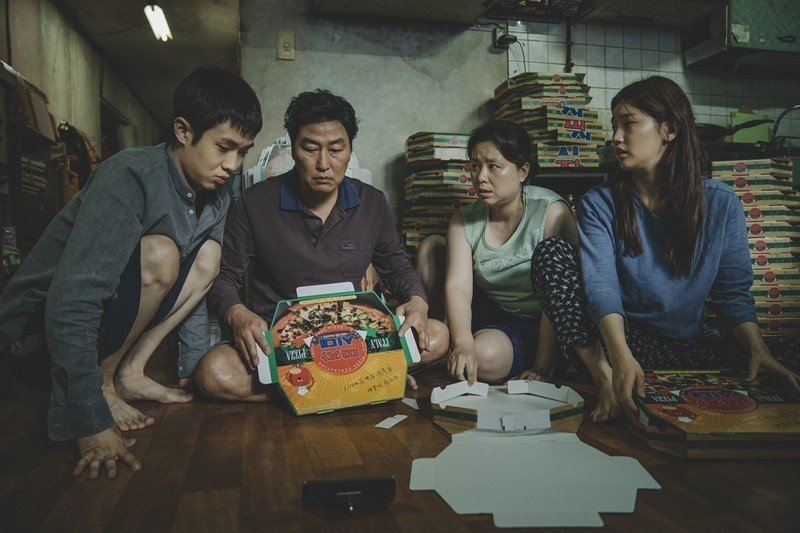
All three occur with Ki-taek. When the Kim family messily flees the mansion during a lavish party, it's raining heavily. The Kim family's basement apartment floods; they can only sleep in a gymnasium overnight. From gathering belongings to waking the next morning when Mrs. Park calls, Ki-taek displays complete emotional flatness. Going back further, actually from when he's criticized for poorly folding pizza boxes, he's already shown no expression, harboring resentment in his heart.
 That blank gaze actually appears whenever experiencing unfair treatment
The second obvious blunted affect manifests the day after the storm when Mrs. Park calls Ki-taek to shop. While on the phone, she mentions "Thank goodness the rain finished yesterday—today we can properly hold the party." For Ki-taek, this is pure injury—his home flooded, leaving nowhere to sleep, clothes selected haphazardly from junk. Unexpectedly, Mrs. Park pinches her nose, a gesture of discrimination.
Various stress factors—doing odd jobs for survival, even experiencing debt default—combined with scent, flooding, and societal mistreatment, finally culminate when Mr. Park unconsciously pinches his nose to block the scent. Ki-taek deepens his conviction that "everyone targets him." In that instant, his gaze shifts dramatically, he loses control, grabs a knife to kill. All signs indicate Ki-taek has developed schizophrenia.
 The light above Mrs. Park extends downward to the deep place where Morse code is transmitted. Its relative position, viewing from the courtyard inward, is the lower right corner of the house.
Moreover, the basement's symbolism: the resident would headbutt a button below, causing lights to flicker in Morse code. Comparing the circuit upward with the interior layout, then viewing from the courtyard inward, the basement is precisely in the lower right corner of the entire house—matching the film's hint about schizophrenia patients' hidden traces: "the darkness in the lower right corner of the artwork." Therefore, the resident indeed represents a schizophrenia patient.
So, why don't they call for help?
Desperate to Be Understood! The Overlooked Distress Calls of Schizophrenia Patients
Actually, the Morse code the residents emit is a call for help, yet they receive different responses depending on who receives the signal. In the film, there are three types of people:
-
Can understand but cannot help—Dae-song
"Dae-song is a Boy Scout; he must understand my signals," the resident hopes. Indeed, Dae-song does decode the "distress signal" while setting up a tent in the courtyard, but being too young, he doesn't know how to help. This represents reality: knowing someone may need assistance yet still failing to extend a hand. -
Receives the signal but doesn't understand—Mrs. Park
When the lights flicker repeatedly, Mrs. Park merely says "That light is strange—it flickers by itself." This represents those who cannot decode the signal, missing the chance to notice the anomaly and understand deeper. -
Willing to understand and help—Ki-woo
At the story's end, Ki-woo's condition improves. On a snowy day, he runs to a mountain with binoculars to observe the house, also discovering the light's flickering. He writes it down with pen and paper, decoding it on the subway. "I believe sending it every day, someday you'll understand." This is the patient's desperate hope for others to understand—sending tiny messages daily as a call for help. Ki-woo discovers his father has hidden in the basement and vows that if he becomes wealthy, he'll buy the house to let his father come up. This type of person in society is willing to understand patients and willing to help.
Schizophrenia patients desperately want to be "normal people." So when no one understands the signals, the resident repeatedly headbutts until bleeding; at the story's end, Ki-taek hides in the basement, also confirming that the basement represents the schizophrenia patient's inner refuge. Ki-taek is indeed ill and doesn't know what to do.
"She's really a good person, she just kicked me once..."
These are the housekeeper's final words to the resident before her death, driving him to madness as he bashes the wall repeatedly. Yes, if we remained fully good, never suddenly withdrawing or leaving, perhaps society would gradually progress and develop more empathy.
From the artwork, basement, to Morse code, "Parasite" can be interpreted not merely as a film exploring class, but as wanting to tell society: schizophrenia patients exist in an environment of unfair treatment where nobody understands—much like the subtle, unnoticed issues in the film. If we choose to acknowledge the problem and offer care and assistance, wouldn't society's random murders decrease, preventing such tragedies from recurring?