
(Editor's Note: Yang Ya-Qing changed her name to Hua Ya-Qing in 2020)
It's most fitting for me to share my sister's career journey, as aside from our family, no one understands it so well.
"I've never seen someone love their job so much," this is what my family and I think of my second sister, Ya-Qing. A few years ago, she graduated as the top student in the HR track of Taiwan Tech University's Graduate Institute of Business Administration, but her job search hit wall after wall. Whether it was Acer, Taiwan Cement, or HTC and other tech companies, about ten enterprises rejected her across the board. Many even reached the second round, requiring video submissions and presentations. I even used my media expertise to give advice and shoot videos for her, but these companies ultimately rejected her anyway, causing her to lose confidence, feeling depressed and lost every day—until she interviewed at Sinyi Realty.
"The interviewers gave me the feeling that they were willing to wait for me." Because she had just graduated with no experience, and nearly 10 companies had rejected her, she was actually terrified of interviews. But at Sinyi Realty, Ya-Qing said, "They asked deep questions that required thought before answering, and they were willing to understand my perspective." Unlike other companies that just wanted to know if I could be used immediately, or how I'd catch up without experience. "Even when I said HR is a very professional field, the manager laughed." They weren't laughing because they thought she was cute or earnest—they were laughing thinking, "How is HR even a profession?"—belittling their own department, which made Ya-Qing very uncomfortable.
But when she shared this same point with Sinyi Realty's interviewer, they nodded in agreement. In that moment, Ya-Qing felt recognized. Both parties' values aligned perfectly. More importantly, they didn't care that she had no work experience; instead, they valued her personal qualities. Like me, my sister graduated from a national graduate school through the evening division program, just from the technical vocational system. "I felt that Sinyi saw me—the effort and drive in this journey." Because of this difference, after the interview, Ya-Qing was eager to join the company.
That year she started as an HR staff supporting the real estate agents, managing the attendance of five thousand sales agents. I happened to be studying in Korea and wasn't in Taiwan. Around year-end that year, she received a small bonus because "her efforts were recognized." At the time, I thought it was quite special. How often does someone receive a bonus and certificate after just six months, and get to lead group dancing exercises at the manager's monthly meeting? To me, it seemed the company really saw her performance.

After I returned home, my eldest sister often mentioned to me that Ya-Qing really loves her job. Our home is near Danfeng MRT Station in Xindian, and her company is across from Taipei 101—basically the starting and ending points of the Taipei MRT. A one-way commute is about an hour, round trip is two hours. The company starts at 8:30 AM, and many people in such a long commute might just barely make it on time for clock-in, but Ya-Qing wakes up at 6, arrives at the office around 8, finishes breakfast, gets organized, and starts working seriously at 8:30, without wasting time. As someone who dislikes commuting, I would have given up after two months, but she maintained this routine for about three years.
At the time we all thought it was strange—why be so diligent? She said "because my senior did it that way." Your first boss's work attitude and standards definitely influence your own behavior, so she treated her "senior" as a role model. But mentioning "senior" naturally raises questions—did the company have a strict hierarchy system? But later, calling the office several times to find her, I discovered that employees address everyone as senior, regardless of who they are. There's no junior title creating an upper-down hierarchy—instead, there's mutual respect. Even meeting the chairman, everyone calls him "Mr. Zhou."

As a staff member, Ya-Qing once reported directly face-to-face with "Mr. Zhou." What struck her was that when her report had some blind spots, "Mr. Zhou" didn't directly point out the problems in the meeting and demand changes. Instead, he asked her what she thought about the issue, why she felt this way, and how she might adjust it. Using a guiding approach, he helped Ya-Qing see the blind spots in her own report and figure it out herself, rather than killing her ideas from the start or blocking development. Instead, it was two-way communication, helping both move toward better directions. Of course, people would think Sinyi is a great company, but this still doesn't fully show how much Ya-Qing loves her job.
Here's an example that still seems outrageous to me. One night before bed, I walked into her room and saw a book with a green cover on her desk with a bookmark. Out of curiosity, I flipped to the front and read the title: "Trust Brings New Happiness—The Story of Sinyi Realty." Just from the title I was shocked—how could someone look at their company's book at home after work? The real kicker was it was the chairman's autobiography. I used the book to tease my sister, and she seriously said, "No, I was just reviewing it!" "Reviewing?" Turns out she wasn't just reading the autobiography—she was reading it for the second time. I was completely defeated.
(Below: This April, she even read the chairman's second book…)

There was also a "Rookie Unleashed" recruitment event the company held a couple years ago, asking applicants to watch a movie, where someone would dress as a giant bird mascot as the rookie. Many people would decline or think it was silly, but she excitedly took on the job, saying she wanted to contribute to the company. On the way home, mentioning that the company should have hired a model instead for better appeal, she said the budget was limited, then seriously suggested "If I lose weight and become the model myself, the company won't have to spend money!" Again I thought, "How can someone like their job this much?"
I believe that besides her naturally being a stable person, the company is also willing to provide development space and preserve each employee's individuality. Whether in training, company philosophy, or value cultivation, they uphold the idea that valuing talent makes it easier to retain talent. From my observation, I've never heard her say a single criticism about the company. In this age of world-weariness, I think people who don't complain about their companies are rare, and finding a good company is even more precious.
(Image: Ya-Qing and colleagues leading group dancing at the monthly meeting)

Generally, people who sit in offices for a while get lazy, but my sister had an opportunity a year ago to transition to sales as a real estate agent. However, she wasn't a real estate professional, so she hesitated a long time before the transition. Although the company would provide complete training, the extended work hours meant moving closer to her branch, away from home. And she had never lived independently before in her 30 years.
Household chores like doing laundry, washing dishes, cleaning the bathroom—she'd need to handle everything herself after moving out. Additionally, my sister's personality is shy. She wasn't used to how people's perceptions would shift from seeing her as a "person" to seeing her as a "real estate agent," bringing defensiveness. Sales also involves techniques like persuasion and negotiation with clients—all things that caused her real suffering in the early days of the transition.
All this pressure and sales targets stressed her greatly. We often heard she cried at the branch. She especially hated going to empty properties alone because she had some claustrophobia. All of this went against her originally calm and stable nature. However, the growth pain from stepping out of her comfort zone was also part of why she wanted to transition to sales—to force herself to mature.
(Image: Just after transitioning to sales, struggling to adapt but continuing to work hard)
 (Below: Each conversation is an opportunity)
At that time she described it as, "I'll just pretend I'm studying abroad at a language school!" With the job and environment changing, her personality had to adapt too. Although she had countless moments wanting to quit, her superiors stood by her side, giving encouragement. When things weren't going well, they'd lend a hand, care for her emotions, and provide support in daily life—not like many companies that just want employees to catch up quickly without slowing down the team.
Eventually, after self-reflection, she set a goal to get promoted and win an award. She started visiting homes in her territory door-to-door every day, organized customized visit records, sent hundreds of self-introduction letters, and approached the difficult challenge of real estate sales with sincere dedication, treating the job as a long-term business venture. Within just six months, she won the "Rookie Award"—an award that can only be won in the first half as an agent, a once-in-a-lifetime opportunity.
Note: In Ya-Qing's territory, no one had won the Rookie Award in four years.
(Image: Ringing doorbells one by one)
 (Below: Asking the community security guard for permission to post promotional materials)
Of course, she maintained her love for the company. Often when I'm doing news reports, I need to ask about housing prices. One day I asked her about "Actual Price Registration," where to check it. After she gave me the website, I asked, "So the prices there must be real?" She said she wasn't quite sure, but "if you buy from Sinyi Realty, it definitely is!" I foolishly asked again, "So you're advertising?" My sister seriously replied, "No! It's true! Everything from us is real." Oh my, I was just joking—don't take me so seriously!
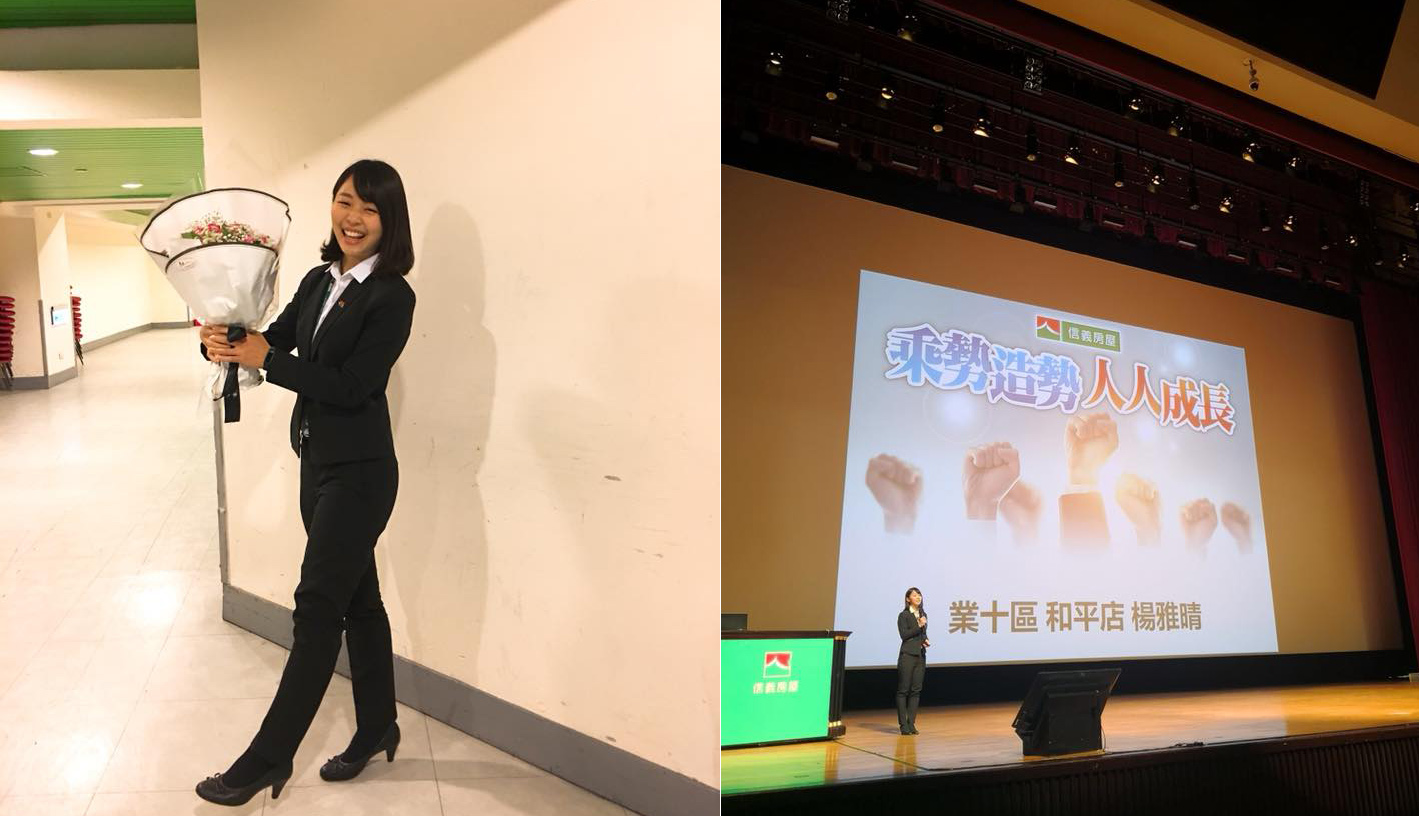
(Below: After winning the Rookie Award, many branches asked her to share her experience.)
After the Rookie Award ceremony, she was no longer the shy rookie leading group dancing. Instead, she stood on the monthly meeting stage sharing her experience with thousands of more senior agents. Managers from other branches also took notice and invited her to share this life experience with their teams, expressing their appreciation with "hand-palms-down" applause.

(Image: The Rookie Award Trophy)
Now she's been in sales for a year. Beyond growth, one of her original goals was to save money to help her mom move to an elevator apartment. While it's premature to say if a move will happen, her attitude of thinking about her family, her love for her work, treating the job as a long-term career venture—from administrative HR to frontline support, weathering the period of confusion to gradually find her position in her professional field—speaks volumes.
(Below: The longer you work, the more you understand the life meaning a job brings)