By Karen Yang
"All professions are inferior; only reading is superior" is a Confucian philosophy and a traditional value in the Chinese world. Taiwan's society once prevailed with the sentiment that "attending a good university and finding a good job means a hopeful future." However, as society gradually transformed and public consciousness rose, people began to recognize that reading is no longer the only option. The Ministry of Education initiated a series of educational reforms and policies to establish more universities. Years later, these policies led to the closure of private schools. Jobs that didn't prioritize education or academic credentials faced higher barriers to entry and declining salaries, making the younger generation the "working poor," unable to improve their circumstances and uncertain about the future.
Looking back at Taiwan's educational policy reforms: In 1994, the government established the Educational Reform Advisory Committee in response to calls for reform and passed the Teacher Training Law. In 1996, elementary schools implemented a single curriculum with multiple textbooks. In 1997, junior colleges and colleges were allowed to upgrade to university status. In 1999, high schools implemented a single curriculum with multiple textbooks. In 2002, junior high schools also implemented this system. In 2014, the Twelve-Year National Education program began. Until this year, when the 108 curriculum took effect and university entrance exams adopted the "choose 4 out of 5 subjects" format—even with a zero score in any subject, students could still enter university. While this appears to reduce student burden on the surface, emphasizing humanities literacy and extracurricular learning opportunities actually triggered concerns about "wealth inequality." After all, some students' families simply cannot afford to support them in volunteering or attending workshops, and many don't even know where to find information.
On the other hand, while junior and senior high school education is important, the implementation of Twelve-Year National Education coincided with declining birth rates and an excess of universities. Now that entry into university is easy, students progress through 16 years of mandatory education.
Academic credentials have been leveled, student performance standardized by social benchmarks. Without a university diploma, it seems you've already lost at the starting line. How should we address this phenomenon?
Dai Nian-hua, the executive secretary of the Joint Admissions Committee, stated that universities are part of higher education but not part of compulsory education and should not be universalized. This phenomenon also reflects the fact that Taiwan society isn't suited for everyone to attend university.
Given this situation, whether students entering the university system should continue their on-campus education has become a question for young people to reflect upon. According to the latest Ministry of Education statistics, 209,392 students took leaves of absence during the entire 106th academic year. Adding the 91,531 withdrawals, the total number of university students who took leaves or withdrew in the 106th academic year was 300,923, representing 23.6% of the total 1,273,894 university students. In other words, roughly 1 out of every 4 university students took a leave or withdrew. The reasons cited include "work requirements," "misaligned interests," and "financial hardship," among which those choosing to take leaves due to misaligned interests or work needs are notably higher than those facing financial difficulties.
 Chen Po-Yu started his own business, believing that school-based learning is restrictive and that learning directly from professionals is better.
"People who shouldn't have gone to university all went!" Chen Po-Yu is 21 years old and took leaves of absence from both high school and university. Without needing to go through school, he can learn and practice his life direction well. He believes the number of university students taking leaves will only increase.
The overwhelming reason is that Taiwanese parents and schools always promote the idea that "getting into a good university means finding a good job with good income."
However, the transition from learning and student identity to workplace roles isn't something every family teaches. Chen Po-Yu says that even graduates from prestigious schools can "get beaten up badly" when first entering the workplace. Most Taiwanese students don't realize "I need to find a job next year" until third or fourth year, and only then do they look for internships—by which time it's too late, requiring detours to find their passion.
Taking Chen Po-Yu as an example, he first took a leave in his junior year of high school. The college entrance exam was approaching, but he realized he didn't know what he could do after finishing his studies and attending university. Worried about making one wrong step that would lead to many more, he decided to take a leave first to find his direction.
At the time, Chen Po-Yu wanted to be a veterinarian, so during high school summer break he interned at a veterinary clinic. However, without a license, he could only observe from the sidelines. Through entering the workplace, he saw the lifestyle of workers and "became certain about what I don't want." Initially, his family didn't support the decision—not because they believed reading was the only path to success, but because they worried he might go astray without being in school. Later, his parents shifted their thinking, "It became more like trusting that I could control my own life, take responsibility for my own choices, and bear the consequences—good or bad."
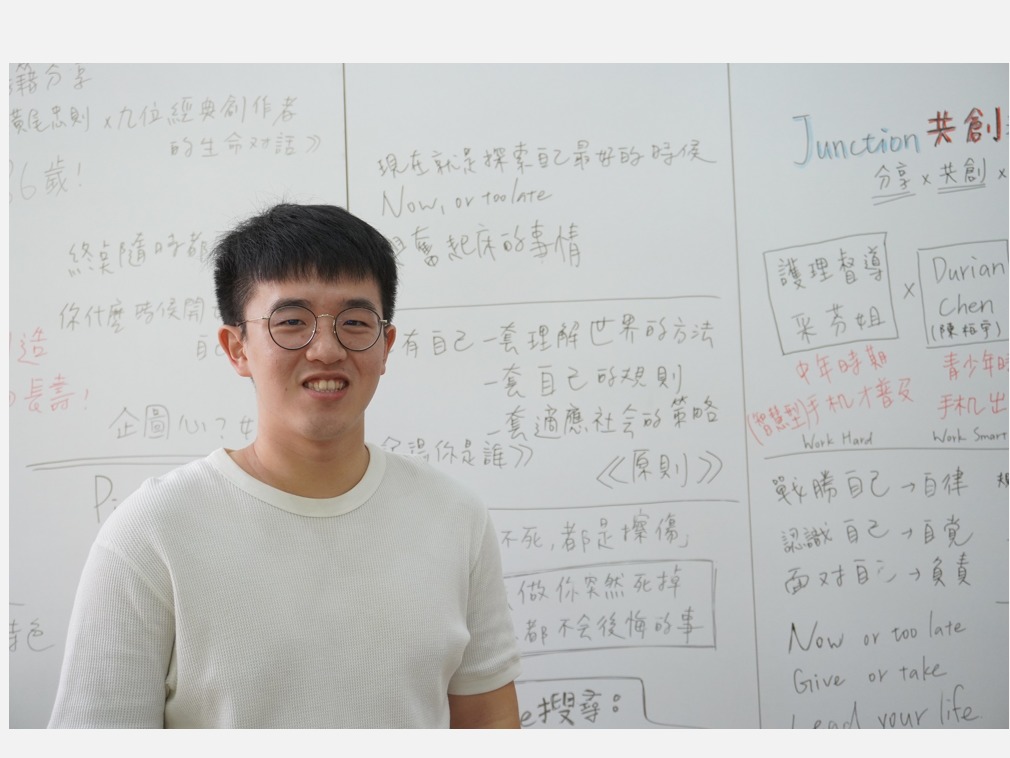 Chen Po-Yu wrote "Now is the best time to explore yourself" in his own startup space.
Chen Po-Yu's second leave was on February 15, 2019—"I remember the date very clearly." It was winter break of his sophomore year at Ming Chuan University, where he majored in New Media Studies. However, he believed that "the teacher didn't give me much—maybe just teaching materials or textbooks, lecturing straight from them. I learn faster on my own." Chen Po-Yu thinks that the media industry requires a lot of practical work and internships. If it's all theory, you realize you could learn it yourself, which doesn't help students much.
When asked if leaving school made him anxious or how it felt, Chen Po-Yu said he felt no anxiety at all. After his first leave, of course he felt lost and uncertain if he was actually absorbing knowledge or making clear progress. At that time, he relied on Facebook to join various professional groups to learn. Now, leaning toward learning marketing and participating in reading clubs, he "learns directly from people who have that professional expertise," enabling faster learning.
Talking about the differences with friends his age, Chen Po-Yu believes that after leaving school, maintaining a livelihood comes first: "You have to earn money before you have the right to talk about learning." His classmates' reactions to his leave of absence fall into two categories. One group thinks it's "unsurprising" because he has his own opinions about many things and frequently participates in off-campus organizations. Many people understand that only about half of him is actually in school.
But the other half of his classmates don't understand: "Won't you regret not having this diploma?" Chen Po-Yu thinks it won't matter because
"My purpose for coming to this school is to learn what I want to learn."
He decided from the start not to graduate, so he also skipped required courses and challenged the system. After all, many startups today care about ability, not credentials. In the future, if he transitions from entrepreneurship to job hunting, he can seek out such companies and pitch what he can offer them.
Scholars analyze that "1 out of every 4 university students takes a leave or withdraws," a situation that includes students not considering aptitude and interests when choosing schools. Diverse admissions have been implemented since 2002 to no avail. The policy of establishing more universities is "fundamentally mistaken." The original hope was to give everyone the chance to attend university, but instead it harmed students, wasted national resources, and wasted young people's youth.
However, as a student on leave, Chen Po-Yu doesn't want to blame the education system: "I think some things are just that way, fixed in place—like your birth family. You can't choose it, so you have to find ways to adapt." Chen Po-Yu's self-directed learning method involves using digital tools to categorize what he wants to learn by topic. Opening his online bookstore wish list, he has collected over 500 books, so many that the list has reached its limit, so he's had to put the rest in a computer folder.
 Chen Po-Yu's book wish list exceeds five hundred items, with many learning records stored on his computer.
Beyond self-study, Chen Po-Yu and his mother opened a co-creative learning space in Sanchong, New Taipei City, providing rental spaces and courses for friends and social groups to exchange and share ideas. This is essentially putting into practice what he learned between his first and second leaves, creating a performance platform. Through sharing, he continues to improve.
Life and learning after taking a leave are not limited by the school system's year-by-year curriculum arrangement. He can engage with the workplace, society, politics, and law earlier, rather than like other students who study, focus on clubs and activities, work part-time, and accumulate experience in fragments. Instead, by directly leaving campus, breaking out of comfort zones, and gaining experience in society, his thoughts, perspectives, and viewpoints are deeper and broader than his same-aged peers, ultimately bringing more benefits than drawbacks for long-term life planning.
Leaving the system and comfort zone isn't so terrifying.