The previous article analyzed checking a company's fundamentals when looking for a job. This second piece moves into the detailed examination of "job conditions"; many newcomers, when starting to look for work, typically browse job listings on recruitment websites. However, some people will impulsively send out resumes after only seeing the "job title", or they "imagine" themselves being capable of doing the work. This results in sending several resumes that seem to disappear without a trace.
"Am I not good enough?"
"Do I really not have anyone who wants me?"
Many friends have messaged me with these questions, often expressing such self-doubt. This happens because we overlook the "match" between our own conditions and the job posting's requirements.
Let's use actual job postings and personal considerations to think through this. During this thought process, please remember to pair it with the four principles

【Consideration 1: Starting Monthly Salary of NT$40,000】 (Note: This section may be more suitable for liberal arts majors / science majors should add NT$10,000)
On recruitment websites, you can see job listings with a monthly salary of 【NT$40,000】.

For those who prioritize money, you might be eager to submit your resume. However, most of these jobs are "sales", "night security guards", "financial consultants", "insurance", or managerial positions. If you're at an entry level and can't handle managerial roles, that leaves only sales. If earning money is your goal and you choose performance-based work, that's a perfectly reasonable decision.

However, if you want more than just high salary—if you also want the work to relate to your interests—then if you're not interested in sales or don't understand it well enough, you might leave due to "poor fit". But if you simultaneously can't accept lower pay, you might hit a roadblock right when you're starting your job search.
【Consideration 2: Experience Requirements】

First, let's look at "experience". If it says 【no experience required】, your resume has a good chance of being opened. But whether you get an interview opportunity depends on your major, school, and how well the job matches the company. You "want" to do this job, but if during your studies or in basic work experience and knowledge you have nothing to show, the company won't dare hire you. That signals you weren't prepared or lack genuine interest. If you were truly interested, you'd naturally accumulate relevant experience during school.
Also, I want to debunk a myth here: when a job requires 【one year or more experience】, from the company's perspective, this requirement targets recruiting newcomers who have some "work experience" or "internship experience". Whether you actually meet the full one year depends on how urgently the company needs someone. If they're very short-staffed, even completely inexperienced candidates from a relevant major might work. If you have related or similar experience—even three months or six months—you still have a chance with that job. Don't give up and refuse to submit your resume just because you see "one year or more"!
Fear is what I think causes resumes to disappear, so don't overthink it. After evaluating, if it seems reasonable, just submit!
【Consideration 3: Job Responsibilities】
When examining a job posting, you need to consider more than just the brief one-line job description. Let me show you a simple example using a recruitment website posting ↓

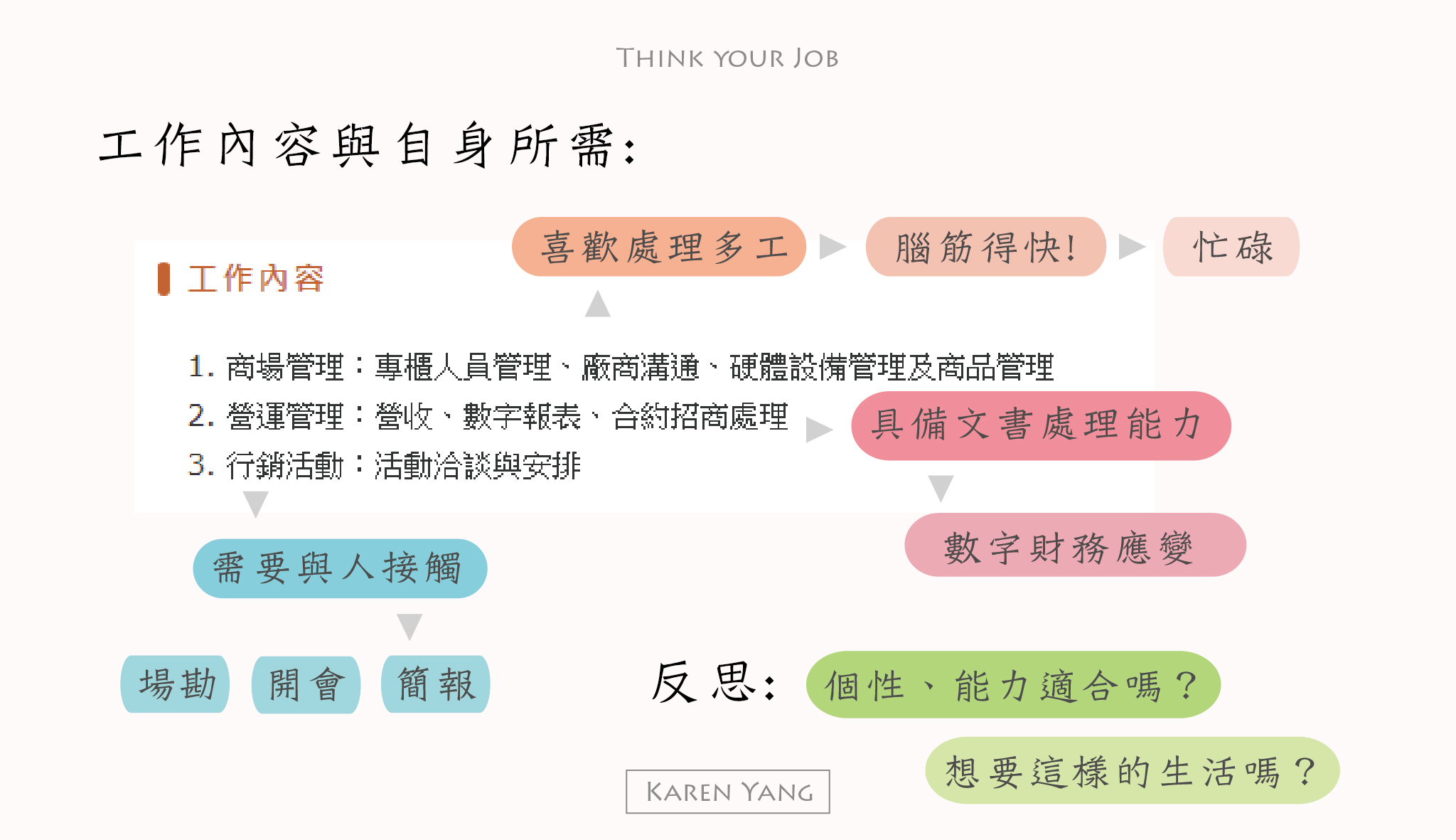
I randomly found a 【Shopping Mall Operations Assistant】 position. The main responsibilities are mall management, operations management, and marketing events. When it comes to mall management, that includes at least four areas of expertise. In other words, this job requires multitasking, handling both hardware and people simultaneously, which means quick thinking is essential. Under such layered pressure, it also means this position is very busy. Do you like that?
Second, it requires operations management—not just people, but also revenue, reports, and contract handling. Clearly, this requires computer document processing skills. It's not just simple typing and Word formatting; you'll need EXCEL skills like pivot tables, formulas, and functions—after all, you're handling reports! And with Word, if there are hundreds of contracts, would you use "mail merge"? Does this level of document processing suit you?
Third, you need to organize marketing events. Organizing events naturally means communicating with many people. This involves site surveys, meetings, and presentations—countless other tasks. It also means not just working within the company but going out to meet with vendors. (Internal thoughts: this job is really busy)
After reviewing all three job responsibilities and considering the required skills, finally reflect: do your personality and abilities suit this? Do you want to live this kind of life? This is crucial. Do you want this busy but challenging lifestyle? Or do you prefer a stable life where you leave on time? It depends entirely on you.
The above are directions I've organized for newcomers, workplace rookies, or those considering career changes to think about. I hope this helps. Finally, let me add: job hunting is a process, not finding a job is just a state—not "if you keep not finding a job, it means you're useless". Patience and persistence matter, and maintaining a good mindset is more important than anything else.
【Five-Step Series for Finding a Good Job—Complete Overview】
Step 2: Job Conditions That Match Your Situation
Step 3: Referencing Others' Interview + Work Experiences is Essential
Step 4: Deconstructing Interview Procedures to Understand Company Culture
Step 5: Re-examining Yourself