To actually find a job you like that won't be short-lived, start with self-reflection first, which can be broken down into several characteristics: "suitable," "enjoyable," "desired," and "adaptable." 
【Live Stream Recap】
Since the live stream covered that aspect, this post focuses on practical assessment methods beyond internal reflection. Here are five steps:
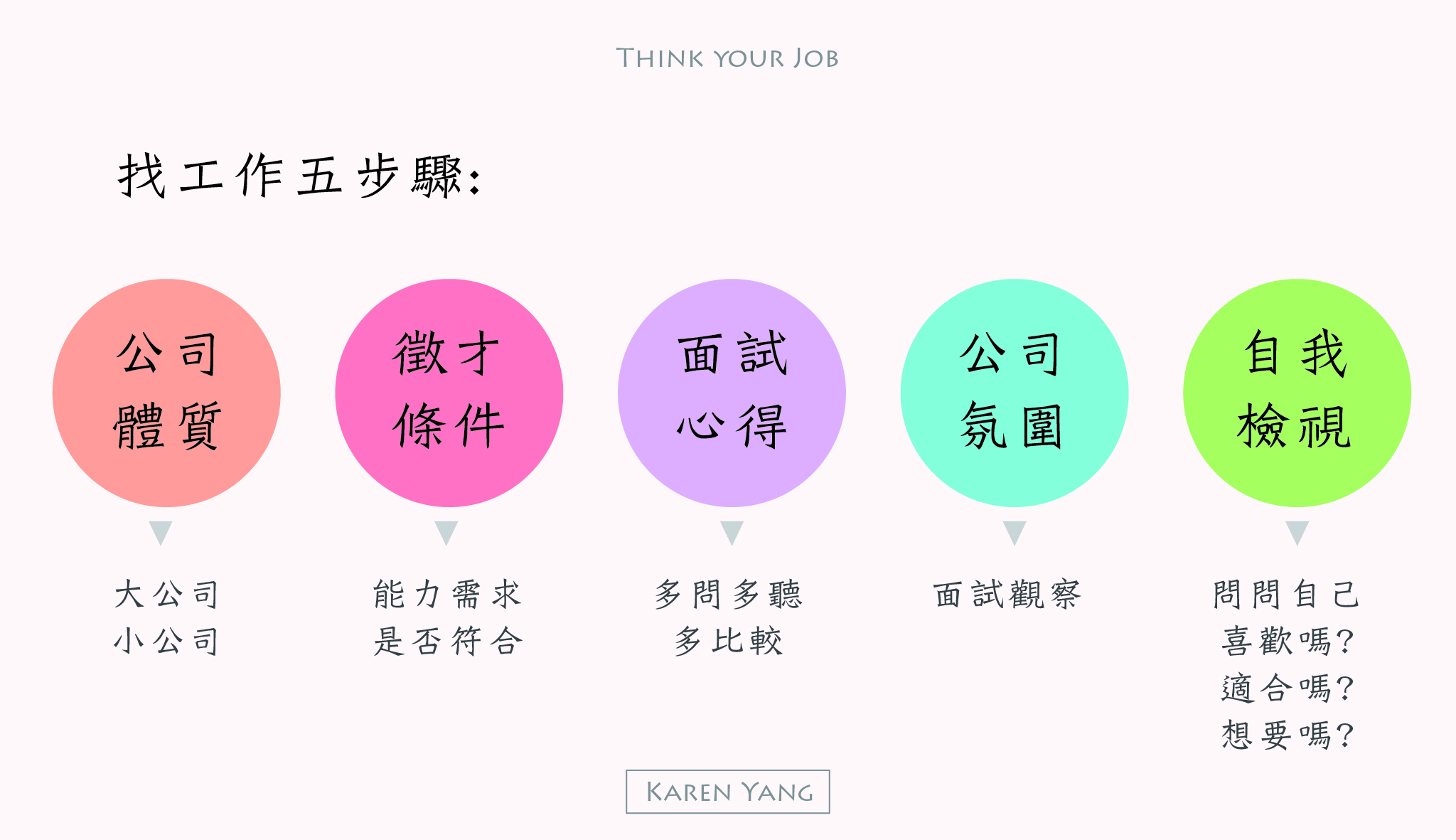
This post covers step one first.
I. Company Health Assessment
Step one, the simplest, is to first understand the company. Don't naively think that just because a friend worked there, it has a big reputation, or a friend thrived there, you can give it a try. Don't skip researching the company and industry just because you "want" the job—check whether the company and industry align with your needs first, because one-sided wishes are quite risky.
But what methods can you use to assess company health?
Let's simply divide this into large companies and small/startup companies.
👩💼 Large Companies:

Public financial statements are one indicator. If your industry is tech or traditional manufacturing that relies on orders, and the company is publicly listed, it will have public financial statements. Within financial statements, there are three places to check if the company is profitable:
1. Profitability Indicator: EPS (Earnings Per Share) - After-tax Net Income
After-tax net income is the money the company earned in a year minus income taxes owed—the remaining profit. If EPS shows positive growth for five consecutive years, it indicates the company has a stable foundation and can weather financial crises. Regardless of how famous the company is externally, this is an excellent indicator. Some famous companies have mediocre EPS—the same logic applies to stock buying.
2. Debt-to-Equity Ratio
To understand the company's debt situation, look at the "debt ratio," which represents the percentage of the company's liabilities relative to total assets. The higher the debt ratio, the tighter the company's financial situation; the lower the debt ratio, the better the financial health.
That said, many large companies have higher debt due to operations—shipping companies, financial institutions have high debt because planes and real estate are expensive. Also, companies expanding operations may have elevated debt for that year. Therefore, review the debt ratio over three to five years.

3. Revenue Growth Rate (Reference source for this section)
Why is revenue important?
(1)Revenue is the foundation of all earnings
After deducting costs, taxes, and other items, a company's profit will always be less than revenue, never more. If absolute revenue is too low, it naturally cannot support significant talent and capital investments, limiting company growth.
(2)For companies to grow, revenue must grow
Conversely, revenue growth doesn't necessarily mean the company grows. Relative figures matter more than absolute ones most of the time. Revenue growth rate often reveals a company's growth cycle, even signs of decline.
(3)Look at revenue growth rate
High revenue growth rate from stable income sources indicates strong growth momentum. If future growth continues, as shareholder equity increases, dividends and stock prices naturally rise.
👩💼 Small Companies:

Small companies, by my definition, have 30 or fewer employees—relatively small organizations with little or modest recognition.
To assess such company health, first understand the company's history: when it was founded, whether it's a subsidiary spun off from a parent company, the founder's background, whether it invests in other industries. Most importantly, check the Ministry of Economic Affairs Company Information Search to learn about capital, industry classification, business operations, and company status to determine legitimacy.
(Note: Simply search the company name)
Also research the owner's background to see if there's negative news, embezzlement incidents, etc. Internet information is abundant nowadays—you'll find something. Or cautiously check Facebook too. It's better than joining and discovering the boss is a terrible person who only exploits employees.
👩💼 Startups:

Startups are trending lately, often tech/software companies with funding like PINKO, Dcard, Hahow, or ShopLine, which have received angel funding or Series A/B rounds. The advantage is more creative freedom, founders usually adapt well to trends, quick pace, and challenging work. The concern is whether company systems and maturity are established.
Here, the founding team's background matters as your assessment focus, including founder credentials, experience, and character. Check for partners and case studies. Of course, evaluate the angel capital backing—funding source stability, company viability, and development potential are all assessable.
Also, at startups, I believe it's crucial whether you have the right mentor and supervisor. Therefore, explore the startup's website to learn about founders and business operations. Through how they manage social media and issue press releases, you can gauge whether they're creative enough and willing to give young people opportunities. (We'll discuss this further later.)
【Benefits Assessment】
Beyond the practical methods above, consider company benefits.
These include annual leave, parental leave, marriage leave, employee trips, flexible hours, snack/coffee areas, education allowances, salary reviews, year-end bonuses, performance bonuses, transportation subsidies, etc. At minimum, comply with Labor Standards and have labor/health insurance coverage. Modern startups usually offer great benefits; large companies tend toward traditional approaches—annual raises, promotion, probation salary deductions, etc. What matters most is clarifying what you actually care about.
【Five Steps to Finding a Good Job - Series Overview】
II. Whether Job Conditions Meet Your Needs
III. Referencing Others' Interview and Work Experiences is Essential
IV. Deconstructing Interview SOP to Reveal Company Culture
V. Re-evaluate Yourself