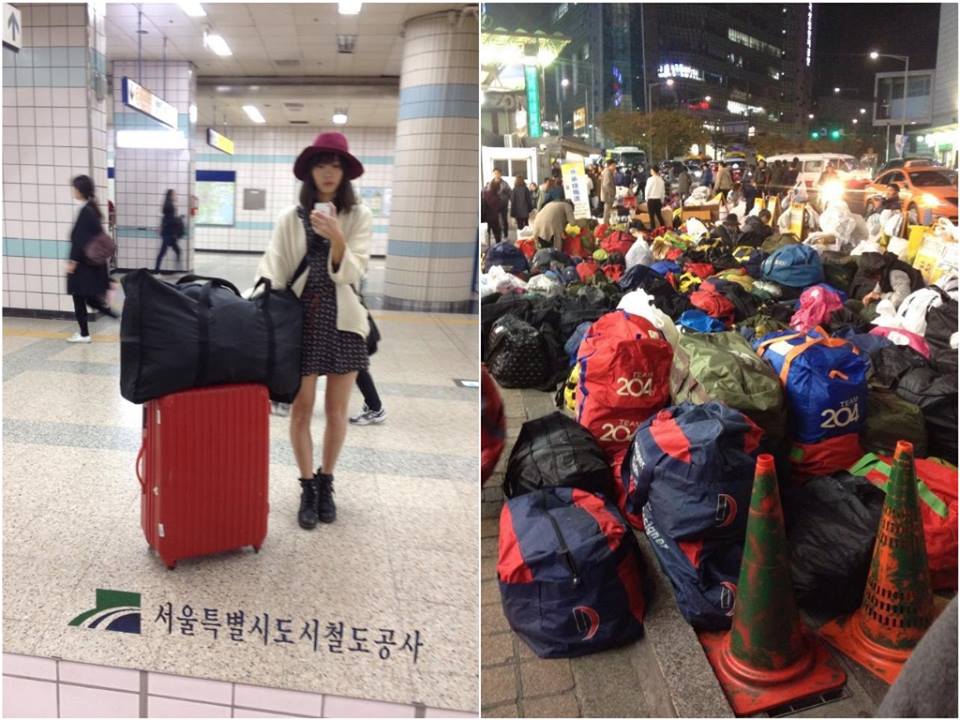
In November 2015, I set off for Korea. This trip was different from my previous travels—not to Busan where I live, but to Seoul's Dongdaemun. Every girl has dreamed of starting her own business. To wholesale source at Dongdaemun, I even took a sourcing course beforehand, but without actually going there in person, I couldn't really understand how to select merchandise, pick items, or negotiate prices.
The day I arrived, Seoul was about 7°C. From 6 PM when Karen entered Dongdaemun until 1 AM, I was sourcing the entire time—carrying a wholesale bag filled with winter clothes, probably about 20 kilograms, squeezing through narrow corridors in the wholesale malls, using my basic Korean to communicate with vendors about colors, quantities, and which customs broker to send the goods to.
Inside the mall, the corridors are barely one person wide. When everyone is carrying wholesale bags this size, you can only bump into each other. The experienced ones carry their bags on their heads and move quickly through the crowd.
Outside on the ground is all the merchandise that customs brokers will transport to mainland China or Taiwan. Vendors wait outside for buyer instructions. During this wholesale sourcing experience, I observed three key points:
1. Are They Wholesale Buyers or Just Tourists?
Karen observed that some buyers need translators, which is actually quite safe because it's like having a complete package—a guide taking you through all of Dongdaemun with instant translation, someone who understands all the ins and outs. You don't have to dig through each shop yourself, and with a "local guide," vendors are more willing to offer wholesale prices.
Other buyers have visited many times and are already familiar with vendors and customs brokers, so the brokers wait outside for instructions and retrieve merchandise from shops. This saves buyers the physical labor of carrying goods.
As for solo visitors like me, you're generally mistaken for a tourist at first. Vendors will come back and confirm that you're buying at least two items or one of each color—what's called "buying the full range." Only then will vendors give you wholesale prices. Moreover, when examining merchandise, you absolutely cannot hesitate too long. Within about 10 seconds, you need to screen and identify the fabric, style, color, and quantity you want. This demonstrates your "eye for quality and professionalism."
Why?
Because vendors also observe the eye of wholesale buyers. They know the habits and movements of experienced wholesalers—including how they talk and their eye contact. Whether a wholesale buyer understands their customers' needs can be observed from just 10 seconds of conversation and eye contact. Here's another key factor: those who speak Korean have an advantage and can negotiate better prices. Those who only speak English get a more indifferent attitude from vendors.

2. Wholesale Sourcing Reveals Market Size Differences Across the Strait
Karen also discovered that Korean vendors are less enthusiastic about Taiwanese customers—not because of cultural differences, but because of "market size." Vendors say Taiwanese buyers always purchase in quantities of 2, 2—very small quantities. That's why some Taiwan vendors fly to Korea twice a month because "they don't have that many customers."
But for Dongdaemun vendors, mainland Chinese buyers are different. They come to see designs and patterns, and each order is in hundreds or thousands of units. These big accounts are exactly what vendors dream of. These large buyers even have the leverage to request that factories develop special samples for them or source specific fabrics. This is why mainland Chinese apparel wholesale pricing can be pushed lower and lower. It's a "volume-based pricing" strategy that ordinary Taiwanese buyers simply cannot match.
3. Even Fabric Labels Can Be Customized with "Made in" Country
Most Dongdaemun vendors are factory-owners themselves, so they can redistribute inventory among each other. Some have clothing hot off the factory line that haven't had labels attached yet. Since fabric labels themselves can be "customized"—with vendor logos and brand features added—if production is from mainland China but quality-controlled by Korea, you can still choose to have the label say "Made in Korea." Production origin is entirely customizable. What else could possibly be real?
4. After Sourcing: The Real Battle Begins at the Hotel
Every vendor gives you a receipt. To control costs, you need to carefully verify each receipt—which piece of clothing it corresponds to—and sort them by category: T-shirts, skirts, jackets, short skirts, etc. Then manually record everything. I did this the hard way. If anyone has a better method, please let me know. I remember getting back to my dorm at 2 AM and organizing until 4 AM to categorize all the clothes and sort out the receipts. Receipts get crumpled during the sourcing process. If you don't organize them properly right away, you'll have trouble tracking costs later, recording which vendors were good or bad and their locations. Without this, next time you won't know which vendors you can continue sourcing from.