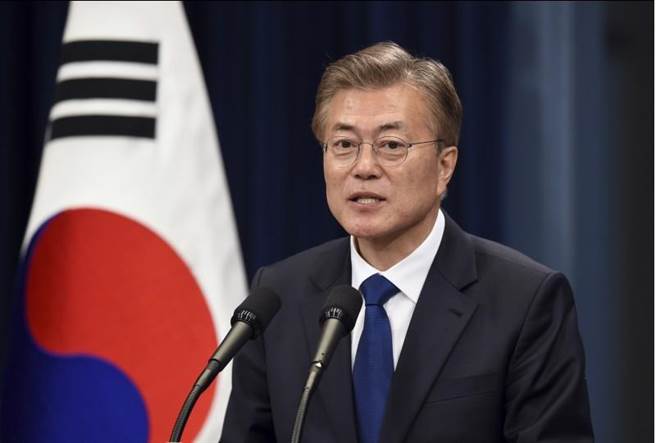
South Korean President Moon Jae-in announced on the evening of the 7th that South Korea's per capita income has broken through $30,000 USD, and the International Monetary Fund (IMF) estimates that South Korea's per capita income this year will continue to climb, exceeding $32,000 USD. This means South Korea has become the 7th country globally to join the "30-50 Club"—a country with a population of 50 million and a per capita income of $30,000 USD, simultaneously reaching the threshold of a "developed" nation.
Looking back a decade, in Taiwan, former President Ma Ying-jeou put forward the "6-3-3" policy platform in the 2008 election, which meant:
- An average annual economic growth rate of 6%.
- Unemployment rate reduced to below 3%.
- Average national income reaching $30,000 USD by 2016.
This final policy failed to materialize as planned. Now in 2018, a full ten years later, Taiwan's per capita income stands at only $25,000 USD. Not only has the target not been met, but Taiwan has also been overtaken by South Korea. Lai Wei-jen, deputy researcher at the Gold Training Institute, points out that "when President Ma took office, he was actually in a position of higher economic standing, but after the financial crisis, the domestic economy faced a significant downturn, which was the main reason why the 6-3-3 policy was difficult to implement."
In fact, looking back at the 1970s, Taiwan's annual economic growth rate reached 9.7%, surpassing South Korea, Hong Kong, and Singapore, ranking first among the Four Asian Tigers. However, by 2004, export volume was surpassed by Singapore, and in 2005, GDP fell behind South Korea. From then on, Taiwan became the last of the Four Asian Tigers. South Korea not only achieved a per capita income of $30,000 USD; export trade volume simultaneously reached a historic high of "600 billion dollars," revealing Taiwan's facing of an economic crisis on the international stage. The main reason is that although Taiwan has signed free trade agreements (FTAs) with New Zealand, Singapore, and other countries, the coverage rate is only 10%—meaning these countries account for only 10% of Taiwan's exports. Even with reduced or zero tariffs, the practical benefits are limited. In contrast, South Korea has signed FTAs with China, ASEAN, the EU, and the United States—Taiwan's four main export markets—with a coverage rate as high as 70%, significantly widening the gap.

What is the impact of FTAs? Korean products exported to countries with FTA agreements enjoy the privilege of zero tariffs, whereas Taiwan's export trade lacks this advantage. It's as if Taiwan-manufactured products can't compete on quality, while being more expensive in price, resulting in insufficient sales that in turn affect the economy. This is why signing FTAs is so important. However, experts analyze that Taiwan's economy isn't necessarily bad; rather, it is structurally weak in overall economic terms. Qiu Da-sheng, deputy director of the Taiwan Institute of Economic Research, says that Taiwan has always been primarily composed of small and medium enterprises engaged in intermediate material production and contract manufacturing. It's not that Taiwan's economic development has been poor in recent years, but because the nature is different and the role in the supply chain differs, South Korea's per capita income gap with Taiwan has been gradually widening.
South Korea has pursued an economy of scale over the past thirty years, with transnational brands like Samsung, LG, and Hyundai Motor. Combined with South Korea's population of 50 million, brand development has advantages and high added value. Taiwan, however, has pursued supply chain assembly with limited added value, while remaining vulnerable to international market fluctuations. With a population of only 23 million, Taiwan's limited domestic market makes brand survival difficult. The particular political circumstances also make it difficult for the economy and international status to achieve major breakthroughs.