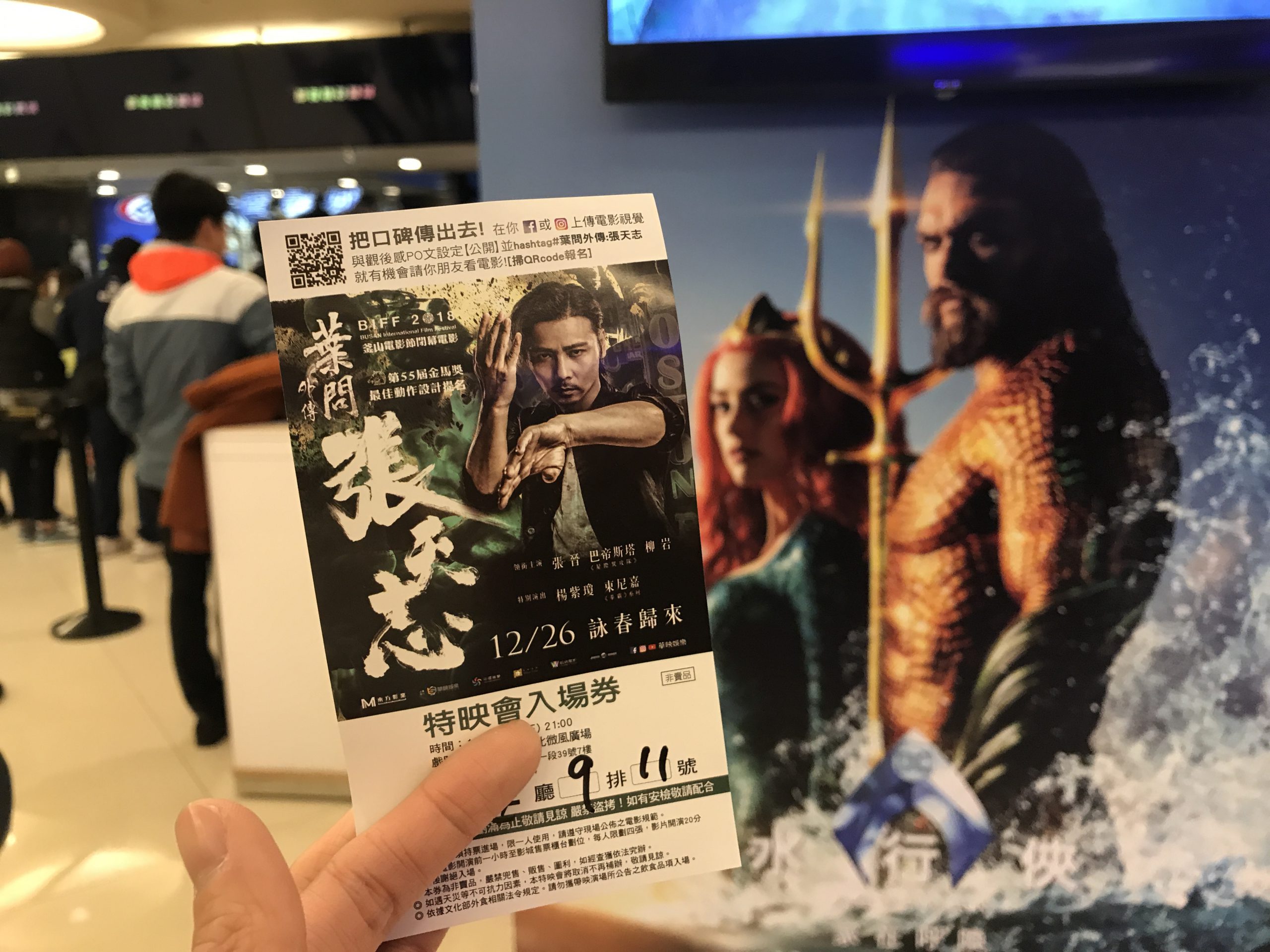

I watched Ip Man ages ago during my student days. It made Donnie Yen a star, and it's been ten years since. Now there's Ip Man Final Stand: Zhang Tian Zhi. I didn't do much research before going to the cinema—I went in with pretty ordinary expectations. But as I watched, my heart kept racing, unsure what would happen next. What surprised me most was realizing this film is "better than Aquaman"—something I never saw coming.
Recently, blockbuster movies have been dominated by superhero films. I enjoy them too, but as I've gotten older, I've increasingly felt that superhero films are just about watching big-screen spectacle and that rush of action. The story is forgotten the moment you leave the cinema. What really stays with you is incredibly little. At most, you leave thinking about how actors perform in front of green screens when everything is fake. Even Amber Heard, who played Mera, admitted in interviews that she sometimes hit the wrong target because it was all artificial.
So when I saw Ip Man Final Stand: Zhang Tian Zhi—a grounded Chinese film without relying on special effects and sound design—I was genuinely amazed. No wonder kung fu and martial arts captivate the world.
Let me compare Aquaman and Ip Man Final Stand: Zhang Tian Zhi across several points below.

Heroes Never Die: Aquaman Relies on Effects for Resurrection, Zhang Tian Zhi's Real Fists Make Life and Death Uncertain
Do you remember experiencing emotional ups and downs while watching a movie? That's what superhero films do—they pack the effects. The underwater kingdom of Atlantis launches a civil war, triggering a massive tsunami that swallows people and cars on shore. Music, effects, and water scenes create grand spectacle. Aquaman and his father drive a truck, naturally caught in the disaster. But following the predictable formula, after the waters settle, the hero emerges, parts the water, drags his mortal father from the truck, uses superpowers to extract the water from his lungs, and brings him back to life. This is exactly what you expect. Heroes don't die, protagonists don't die, doing everything to protect loved ones—no genuine emotion is built.
But Zhang Tian Zhi is different. Every fight scene delivers precise punches while he inevitably takes hits. On Hong Kong rooftops with horizontal neon signs, he stands firmly, leaps and climbs for survival, sometimes teetering on the edge, sometimes using momentum. All of this makes audiences hold their breath, their emotions rising and falling with the character's situation. After winning, they finally exhale. No extra soundtrack or effects needed—the sound of a fist hitting flesh, the clink of blade against blade—it's enough to fully charge emotion, then release it in one cathartic moment.

Both Are Metaphors: Aquaman's "Ocean Waste" is Explicit, Zhang Tian Zhi's "No Choice" Quietly Reveals Hong Kong's Plight
Every film carries deeper meaning behind its production. Aquaman addresses an underwater world devastated by human garbage and ocean pollution causing nature's counterattack. Like The Day After Tomorrow or weather warfare disaster films, it uses news clips and trash floating on beaches as grand spectacle to warn people globally: "Stop polluting the environment—humanity will eventually face nature's revenge." Strictly speaking, it's a cliché.
Most people already know this, but those who don't want to change their ways simply won't. They repeat their mistakes. For example, recently Taiwan heavily fined mainland pork imports, and foreign meat products brought into Taiwan have been smuggled—but people still aren't deterred, literally dumping meat in toilets and pretending nothing happened.
But one line in Ip Man Final Stand: Zhang Tian Zhi left a deep mark on my heart. It comes from a British character: "Chinese is no choice," translated in Chinese subtitles as "Chinese people have no choice." I think this carries profound meaning. Looking back at the film's setting of 1959, when Hong Kong hadn't yet reunified with China and was still "British Hong Kong," in British consciousness, Hong Kong wasn't Chinese—it was merely a colonial "Hong Kong." But "Chinese is no choice" appears multiple times in the film, always spoken by British people (the invaders) to Hong Kong people.
Every time this line is directed at Hong Kong characters, they become stirred with fierce anger. One scene shows many Hong Kong residents gathering in the streets, resisting British officials. So what's the meaning? If we reframe it as "I have no choice to be Chinese," it better captures what the film is trying to hint at—Hong Kong people have no choice but to become Chinese, yet Hong Kong people would never say this themselves. So they "borrow the shell," allowing invaders to bully, oppress, commit misdeeds, and shield each other, polluting Hong Kong. Isn't this quietly revealing Hong Kong people's current predicament?

Homage to "Crouching Tiger, Hidden Dragon"! Michelle Yeoh and Zhang Jin's Duel is the Masterpiece
The most brilliant sequence in the entire film is Michelle Yeoh and Zhang Jin's fight. First they exchange punches, then weapons like swords and staffs. Different from the earlier tension of the rooftop sign-jumping battle, Zhang Tian Zhi invades seeking revenge—like a lamb entering a tiger's den—but he's fearless. This showcases the Chinese cultural spirit of "the brave have no fear." This also happens to be the title of director Yuen Woo-ping's 1981 work; his martial arts films all carry this spirit.
This duel jumps from table to floor, then from window back to table. Flashing blades remind everyone of "Crouching Tiger, Hidden Dragon." Yuen Woo-ping was the martial arts choreographer for Crouching Tiger 1 and director of the sequel. Michelle Yeoh returns, wielding a similar curved blade. Over five minutes of continuous dueling, close-up shots capturing blade movements, wide shots showing fluid martial arts—this sequence is truly spectacular and awe-inspiring.
Walking out of the cinema after watching, my friends and I nodded in appreciation. Ip Man Final Stand: Zhang Tian Zhi is genuinely a stunning martial arts film with meticulous detail and meaningful cinematography. Why describe it further when you can experience its impact yourself in theaters?