Having covered the education beat, I have some small thoughts on the "removal" case this past month. Please feel free to critique me gently.

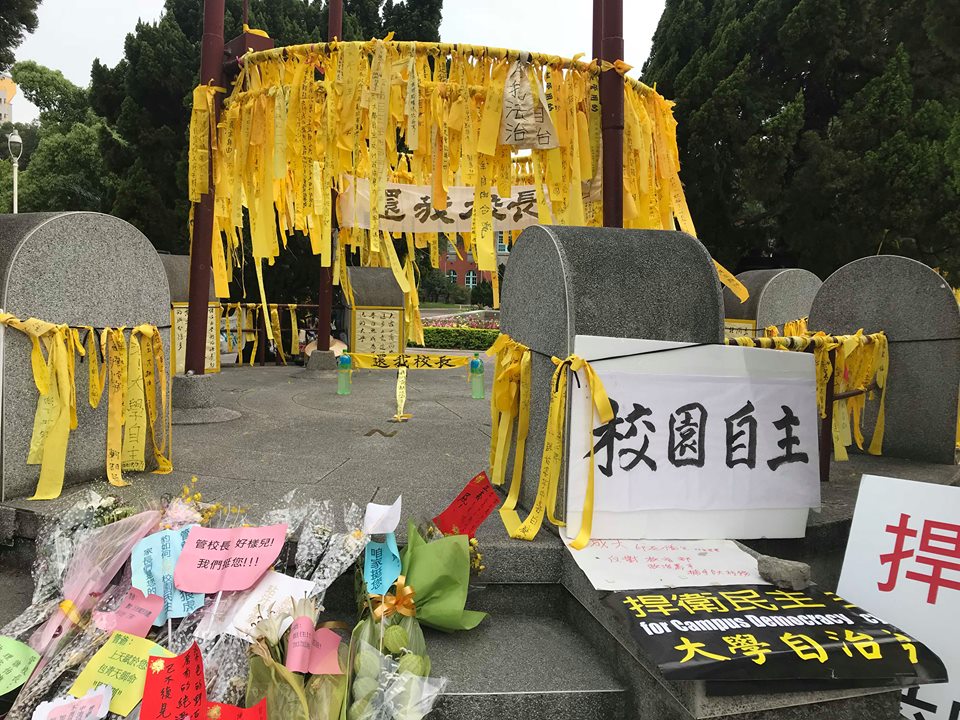
On 4/27, newly appointed Education Minister Wu Mao-hsiung "removed" the president after just 9 days in office, yet the official documents took another 10 days to arrive at NTU.
Upon reviewing the documents, the "independent director timeline" that the inter-ministerial task force had been heavily attacking was hardly the main point. Instead, they focused on "independent director conflict of interest avoidance." Looking closely at the legal basis, there are actually many contradictions!
[Contradiction One: Using Civil Service Regulations to Constrain Specially-Appointed Professors]
The Ministry of Education, citing that "national universities" are administrative agencies, applied the Administrative Procedure Act to the flaws in the university presidential selection case, using Articles 32 and 33 on "recusal provisions" to bind "civil servants" to conflict of interest avoidance in administrative procedures.
However, Education Ministry Deputy Secretary-General Lin Teng-chiao said in an interview on May 3 that "the presidential selection is not an administrative disposition and is not subject to administrative litigation," which is contradictory.
Moreover, Kuan Chung-ming holds the position of "specially-appointed professor" in NTU's Department of Finance. The so-called civil servant status of professors refers to those concurrently holding administrative positions, such as "department chair" or "institute director" (Judicial Yuan Interpretation No. 308). But Professor Kuan Chung-ming does not meet either of these criteria, so he is fundamentally not subject to the Administrative Litigation Act.
[Contradiction Two: Ministry of Justice Letter Interpreting That University Law (Special Law) Should Be Applied First When the Presidential Selection Case is Disputed]
The Ministry of Education invoked the "Administrative Procedure Act," superseding the University Law. However, according to public documents from NTU dated 100 (ROC year), the Ministry of Justice interprets that "although the Administrative Procedure Act has provisions regarding relevant administrative procedures, when other laws have special provisions, the special law should prevail over general law; therefore, such provisions should be applied accordingly." In plain language, when disputes arise, special laws should take precedence over the Administrative Procedure Act—and that special law is the University Law.

Furthermore, Article 9 of the University Law provides: "The selection of a new president of a public university shall be conducted by a presidential selection committee established by the school through an open recruitment process within ten months before the expiration of the incumbent president's term or within two months following a vacancy due to cause. The president shall then be appointed by the Ministry of Education or the respective local government."
Additionally, the presidential selection procedures explicitly specify that dismissal requires confirmation by the selection committee if any of the following circumstances apply:
One: Unable to participate in the selection process due to cause
Two: Has a relationship as spouse, blood relative within three degrees, relative by marriage, or previously had such relationship with a candidate
Three: Has a thesis supervision relationship as academic advisor and student.
However, in the case of Kuan Chung-ming, the elected NTU president, and selection committee member Tsai Ming-hsin, no relationship between the two meets the above circumstances. During the selection period, no candidate raised specific facts suggesting Tsai's potential bias. The Ministry of Education's contradictions are evident.
Building on the above, since the University Law states that national university presidents can be "appointed by the Ministry of Education or the respective local government," does this not also mean that the Taipei City Government has the authority to appoint the NTU president?
Since Kuan Chung-ming was elected on January 5, the Ministry of Education has been using all means to block the path forward. Based on "professional opinions" from an inter-ministerial task force of unknown legal composition, it issued documents to NTU demanding a restart of the selection process. Yet throughout this process, Political Deputy Secretary-General Yao Li-te of the Ministry of Education was a member of the selection committee and had the opportunity to meet individually with candidates starting from 11/28 last year. Why didn't he raise these issues in time instead of only bringing them up after the selection was complete? Who bears the greatest responsibility?
Subsequently, the NTU presidential selection should never be defined as "removing Kuan" or "supporting Kuan." Rather, the harder the Ministry of Education tries to stand on legal grounds, the more unlawful and unreasonable it becomes. By applying legal provisions to imaginary conclusions, it only creates inconsistencies. Even someone like me who doesn't understand law can spot numerous contradictions in the official documents. I believe such disputes will eventually receive a fair response.
Of course, there are financial interests between independent directors and board members, but the special law does not specify what conflicts of interest require avoidance. If Kuan and Tsai must recuse themselves, then why doesn't an Academia Sinica president serving as a selection committee member need to recuse themselves when the vice president is a candidate?
The above represents my personal views and does not represent the company's position.