"Nothing lasts forever, but you always have the chance to start again."
Thank you for sharing.
"Thank you for coming."
 Bullet Journal founder Ryder Carroll in person! (Photo/from author's Facebook)
I only learned after the talk that there would be book signing and photo opportunities. I was lucky enough to get my book signed within ten minutes. I told the author "thank you for sharing," and he kindly replied "thank you for coming." My heart filled with warmth—this is the charm of being approachable.
Bullet Journal founder Ryder Carroll's final special lecture in Taiwan lasted an hour and a half, with content valuable for a lifetime. Some audience members described him as a philosophical thinker. Ryder mentioned that he created the Bullet Journal because he felt there were many things in his life he needed to think through clearly, so he wrote them down by hand. I believe the core of this concept lies in "how well you understand yourself," which then determines how you choose the most suitable way to record. Ryder compared philosophy to drinking water, using a metaphor to illustrate applying philosophy to daily life.
During the talk, Ryder asked "Have you ever experienced a moment of happiness or joy?" Everyone raised their hands!
"Have you ever experienced a moment of unhappiness or misfortune?" Everyone raised their hands.
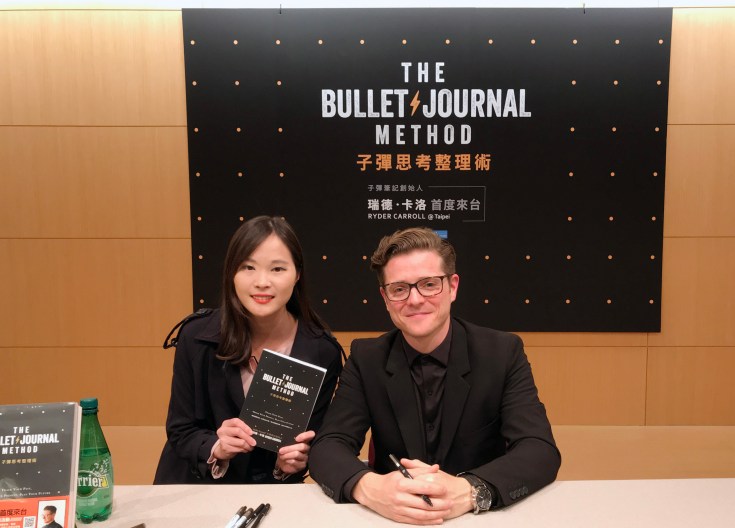 The Bullet Journal author is very approachable in person (Photo/taken by CommonWealth Magazine staff)
He said that everyone experiences both happiness and unhappiness, but because humans are animals with survival instincts, we magnify negative thoughts. It's like asking a child today "How was your day?" and they'll only tell you how bad it was. But if you ask the child to write down both the good and bad things that happened today, you'll discover there were actually many good things, and "life isn't as terrible as it seems."
"Happiness and joy are fleeting," and it's dangerous to try to define what constitutes happiness. Don't lose hope in life or think you're a failure just because you experience unhappiness or misfortune. What you need to do is give something "meaning," make adjustments and corrections, rather than standing still.
During the talk, I took handwritten notes of several phrases that particularly resonated with me. I'll share them below:
1. Asking Why is a process.
The author mentioned that when setting tasks and goals, you must continuously ask yourself why. Through the process of asking yourself why and having dialogue with yourself, you can find the meaning of your goals and understand the bigger picture, and discern what is within your control. Don't waste time worrying about what others think, don't waste time worrying about others' gossip, because you can't control others. The only thing you can control is how you handle situations.
2. Let yourself off the hook; you don't need to pursue a perfect answer.
An audience member shared that in the process of asking why, she discovered she had deceived herself, which filled her with guilt. The author said that discovering this is also important. You need to ask further "why did I deceive myself" and clarify what you truly think. This too is a unique story. Seeking answers isn't about arriving at a perfect conclusion—not everything needs a perfect ending.
3. Handwriting notes is a method for capturing hazy thoughts.
At a previous sharing, someone asked whether Bullet Journals could be digitized. The author responded that humans have fifty thousand thoughts a day, but the gaps between each thought are thinking time. However, we're often filled with digital devices, and when we feel bored, we pull out our phones, becoming distracted and losing the rare opportunity for quiet, focused thought.
Using digital devices for note-taking is certainly efficient, but it actually makes you rush to record everything you hear in the moment, forgetting to focus on listening and recording carefully.
With handwriting, because you can't record every single word and sentence, you become especially attentive to listening, think more deeply, and prevent your mind from "jumping around." You can capture the key points worth recording and engage in dialogue with yourself.
(I especially like how the translator used the word "hazy" because it captures the essence of thoughts flowing swiftly.)
4. Bullet journaling isn't just about note-taking; it's about settling your life.
The essence of bullet journaling lies in whether you engage in "conscious thinking," turning it into a productivity tool rather than just creating a beautiful notebook. Expand your perspective, review your notes to reflect and organize your emotions and thoughts. Know what you're doing and what it means, filter your goals, and uncover what's truly important in life, rather than getting lost in meaningless trivialities.
5. What you accept is what you become.
We often manage many tasks, most of which come from our boss, family, friends, etc. But if you give yourself to others, what will be left for you?
6. Stay on the path toward your goals.
Life has too many tasks and to-do lists. The function of bullet journaling is to review your goals and adjust direction, constantly checking whether what you're currently doing aligns with what you wanted to do. If you've strayed from or are moving away from your goals, you need to trim your list, continuously optimize your objectives, and let your bullet journal become the library of your life.
Quick purchase: https://www.books.com.tw/products/0010803003

Bonus: How Karen Uses Her Planner
About "bullet journaling," it's actually a time management method. As for "planners," I've loved planning since high school. I didn't realize this was also a way of recording and reviewing life using bullet journals and a "navigation system." I only realized this through the speaker's sharing, so I want to take this opportunity to share my 2011 "university planner."

When I was a third-year student preparing for graduate school entrance exams, I used this planner as an example for setting goals. I had applied to seven graduate programs, so I hand-drew a timeline from each school's date to the application deadline on the left side, then wrote the names of each professor who would write me recommendation letters to track when I needed to ask them. (Turns out I was managing people upward at 21! 😂)
In the daily table, I'd write what needed to be completed each day, with to-do items on the right side. For events, I'd write the time, check off what I completed, and cross out what I didn't. Application deadlines were in special colors, and graduate school work to prepare was highlighted with highlighters.
 Red lines mark the starting points, with the names of each school's recommendation letter teachers written on both sides.
I would open my planner every day to check if I'd completed my tasks. I changed planners every year. If I didn't have my notebook with me, I'd feel particularly anxious—just like most of the speakers shared today.
For me, this method genuinely gave me a sense of security, allowing me to control my time. Beyond that, the most precious part is reviewing years later to know whether I was good to myself back then, whether I wasted myself, or how I got through my most vulnerable moments.
This probably internalized into my next step: "life management." But the difference between me and bullet journaling is that I lack systematic structure, especially in setting goals and daily review methods!
If you like my articles, follow my blog or fan page: https://www.facebook.com/karengirl503/